
Ashtanga Yoga: The Eight-Limbed Way to a Balanced Life
Ashtanga Yoga is a traditional path that brings together movement, conscious breathing, focused attention, and inner awareness. Rather than treating yoga as only physical exercise, it encourages a more mindful and balanced way of living. Its structured approach helps develop strength, flexibility, stability, and concentration through regular practice. However, the deeper value of Ashtanga Yoga lies beyond the yoga mat. For example, its principles can guide us to become more aware of our thoughts, actions, habits, and responses, helping us live with greater discipline, clarity, and purpose.
Ashtanga Yoga – What is it?
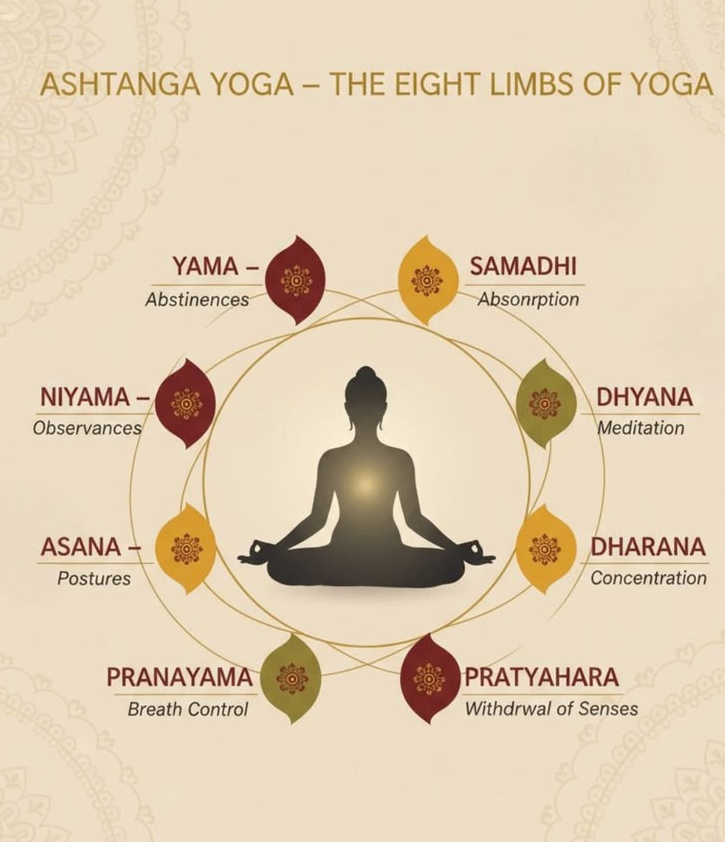
Ashtanga Yoga is often understood as another style of physical yoga, similar to Iyengar Yoga or other modern approaches. However, in the teachings of Patanjali, Ashtanga Yoga has a much broader meaning. Ashtanga comes from two Sanskrit words: Ashta, meaning eight, and Anga, meaning limb or part. Therefore, Ashtanga Yoga refers to the eight-limbed path of yoga.
The eight limbs are Yama, Niyama, Asana, Pranayama, Pratyahara, Dharana, Dhyana, and Samadhi. Rather than being completely separate practices, they can be understood as connected aspects of a yogic way of life. Together, they guide a practitioner from ethical living and self-discipline toward greater concentration, meditation, and inner awareness.
Patanjali presented this framework in the Yoga Sutras, organizing important yogic principles into a systematic path. However, he did not invent yoga; yogic ideas and practices existed in India long before his time.
Unlike the modern view of yoga as mainly physical exercise, Patanjali’s Ashtanga Yoga considers the whole person—behaviour, habits, body, breath, senses, and mind. For example, regular practice can encourage greater self-awareness and balance in everyday life. The journey ultimately leads toward Samadhi, a state of deep inner absorption and spiritual realization.
1. Yama – The Yamas of Ashtanga Yoga: Ethical Foundations for Life
Yama is the first limb of Ashtanga Yoga. It teaches us how to conduct ourselves in our relationships with other people and the world around us. There are five Yamas:
Ahimsa – Non-violence:
Ahimsa means avoiding harm through our actions, words, and thoughts. In everyday life, we can practice it by speaking kindly, avoiding unnecessary arguments, respecting animals and nature, and being less critical of ourselves.
Satya – Truthfulness:
Satya means being truthful. It encourages honesty while also reminding us to communicate with kindness and sensitivity. We can practice Satya by being honest in our relationships, admitting our mistakes, and keeping our promises.
Asteya – Non-stealing:
Asteya means not taking what does not belong to us. It goes beyond simply taking material possessions. Taking credit for another person’s work, wasting someone’s time, or using someone else’s ideas without acknowledgement can also go against this principle.
Brahmacharya – Moderation:
Brahmacharya is commonly associated with self-control and the wise use of our energy. In everyday life, it can mean avoiding excess and learning to use our physical, emotional, and mental energy wisely.
Aparigraha – Non-possessiveness:
Aparigraha teaches us not to become excessively attached to possessions, status, or material things. We can practice it by buying only what we need, appreciating what we already have, and learning to let go.
Yama reminds us that yoga begins not only with how we move our body, but also with how we live and treat others.
2. Niyama – Niyama in Ashtanga Yoga: Personal Discipline and Inner Observance
The second limb of Ashtanga Yoga is Niyama, focuses on personal discipline and our relationship with ourselves. There are five Niyamas:
Saucha – Cleanliness:
Saucha means cleanliness and purity. It includes keeping our body and surroundings clean and also developing greater clarity in our thoughts and habits.
Santosha – Contentment:
Santosha means learning to be content with what we have. It does not mean giving up our goals. Instead, it teaches us to appreciate the present instead of constantly believing that happiness will come only after achieving something else.
Tapas – Discipline:
Tapas means discipline, dedication, and consistent effort. Following a regular yoga practice, maintaining healthy habits, waking up on time, or continuing with something even when motivation is low are simple examples of Tapas.
Svadhyaya – Self-study:
Svadhyaya means studying ourselves. It encourages us to observe our thoughts, emotions, reactions, and habits. Keeping a journal, reading meaningful books, or simply reflecting on our behavior can help us understand ourselves better.
Ishvara Pranidhana – Surrender:
This principle encourages devotion, humility, and surrender to a higher reality. In everyday life, it can mean doing our best while accepting that we cannot control everything.
Together, Yama and Niyama create a strong foundation for the practice of yoga.
3. Asana – The Practice of Yoga Postures
Asana, the third limb of Ashtanga Yoga, is the aspect of yoga most familiar to people today. It involves physical postures practiced with awareness, steadiness, and mindful breathing. Through regular practice, Asana can improve strength, flexibility, balance, coordination, and overall body awareness.
However, Asana is not simply about becoming physically flexible. As we practise, we learn to observe the body, recognise its limitations, and develop patience rather than forcing ourselves into a posture. In this way, the practice gradually develops both physical stability and mental awareness.
Moreover, Asana prepares the body and mind for deeper aspects of the yogic path. A steady and comfortable body makes it easier to sit for practices such as Pranayama, Dharana, and Dhyana. Therefore, the true value of Asana goes beyond physical exercise—it becomes a practice of awareness, discipline, and inner steadiness. Most importantly, Asana teaches us to become present in our own body, one breath and one movement at a time.
4. Pranayama – Working With the Breath
Pranayama is the fourth limb of Ashtanga Yoga, centred on mindful breathing. Because the breath is closely linked with our mental state, learning to observe it can help us develop greater calmness and awareness.
For example, noticing the breath during stressful moments can create a pause before we react. However, Pranayama is more than simply taking deep breaths; it is about understanding and working with the breath consciously.
5. Pratyahara – Turning the Attention Inward
Pratyahara is the fifth limb of Ashtanga Yoga and teaches us to become less controlled by constant sensory distractions.
For example, spending a few quiet minutes without a phone or other stimulation allows us to notice our inner experience. Because the mind is constantly receiving information, learning to step back helps prepare us for deeper concentration and meditation.
6. Dharana – Concentration
Dharana is the sixth limb of Ashtanga Yoga and focuses on developing one-pointed attention. We choose an object of focus and gently return to it whenever the mind wanders.
For example, focusing on the breath during meditation can strengthen concentration. However, this skill is equally useful in daily life when we give our full attention to one person or one task.
7. Dhyana – Meditation
Dhyana is the seventh limb of Ashtanga Yoga and represents a deeper, continuous state of meditation. Instead of constantly following every thought, we learn to observe the mind with greater awareness.
Because meditation develops gradually, regular practice is more important than trying to achieve a particular experience. Over time, Dhyana can support greater clarity and self-awareness.
8. Samadhi – The Ultimate Goal of Ashtanga Yoga
Samadhi is the eighth and deepest limb of Patanjali’s Ashtanga Yoga. It describes a profound state of meditative absorption and inner awareness. However, Samadhi is not something a beginner needs to chase. For example, practising ethical living, Asana, Pranayama, concentration, and meditation builds the foundation for deeper yogic understanding.
The journey of Ashtanga Yoga is gradual—moving from discipline and awareness toward concentration, meditation, and deeper inner transformation.
How Can We Practice Ashtanga Yoga in Daily Life?
One of the beautiful things about Ashtanga Yoga is that its principles can be practiced anywhere.
-
- We can practice Ahimsa by speaking with kindness.
-
- We can practice Satya by being honest.
-
- We can practice Asteya by respecting other people’s time and belongings.
-
- We can practice Brahmacharya by using our energy wisely.
-
- We can practice Aparigraha by reducing unnecessary attachment to possessions.
-
- We can practice Santosha by appreciating what we already have.
-
- We can practice Tapas by developing discipline and healthy routines.
-
- We can practice Svadhyaya by reflecting on our thoughts and actions.
-
- We can practice Asana through regular mindful movement.
-
- We can practice Pranayama by becoming more conscious of our breathing.
-
- We can practice Pratyahara by taking regular breaks from digital distractions.
-
- We can practice Dharana by giving our full attention to one task.
-
- We can practice Dhyana through regular meditation.
These practices may appear small, but when followed consistently, they can gradually influence the way we think, behave, and respond to life.

Why Is Ashtanga Yoga Important?
Ashtanga Yoga is important because it offers more than physical exercise. It is a holistic yogic path that supports the development of the body, mind, and awareness. The eight limbs of Ashtanga Yoga—Yama, Niyama, Asana, Pranayama, Pratyahara, Dharana, Dhyana, and Samadhi—provide guidance for living with greater balance and self-awareness.
However, the practice is not limited to what happens on the yoga mat. Asana helps develop physical strength and stability, while Pranayama brings greater awareness to the breath. The other limbs encourage discipline, concentration, meditation, and inner reflection.
For example, regular practice can help us become more mindful of how we think, speak, and respond to everyday situations. Over time, Ashtanga Yoga encourages greater self-discipline, calmness, and awareness, helping us approach life with more balance and clarity.
Conclusion
Ashtanga Yoga is a timeless eight-limbed path that brings together ethical living, personal discipline, physical practice, breath awareness, sensory control, concentration, meditation, and deeper inner awareness. Its teachings, presented systematically by Patanjali in the Yoga Sutras, continue to offer valuable guidance for modern life. You do not need to completely change your lifestyle to begin practicing Ashtanga Yoga. Start with small steps. Be kinder in your words, more truthful in your actions, more disciplined in your habits, more aware of your breath, and more present in your daily activities. Over time, these small practices can create meaningful changes.
Yoga is not only about touching your toes or holding a difficult posture. It is about becoming more aware of who you are and how you live. That is the deeper beauty of Ashtanga Yoga—the journey from the body to the breath, from the breath to the mind, and from the mind toward deeper self-awareness.
Pingback: Sattvic Ahara: A Yogic Diet for a Calm Mind & Healthy Body